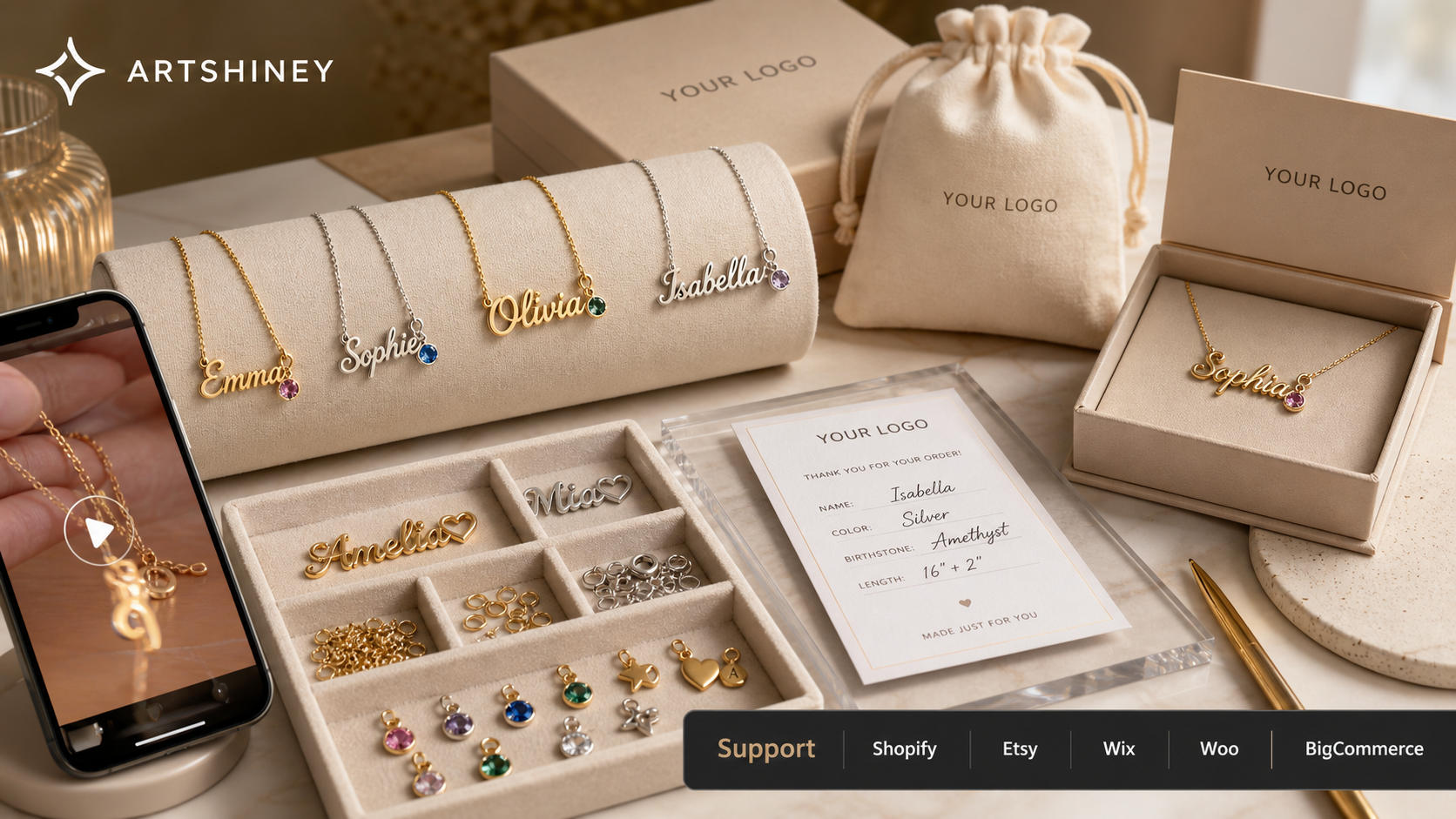

Personalized jewelry is easy to treat as a marketing phrase, but for ecommerce sellers it is a real operating model. A name necklace, birthstone charm, engraved pendant, or curated charm necklace can travel well on short-form video because the product has a story before the customer even opens the package. That same story also raises the standard for production accuracy, packaging, delivery promises, and review management.
For this article, August 2026 Google Trends checks in the United States showed stronger near-term relative interest for name necklace and charm necklace than for broader personalized jewelry phrases. In the past 30 days, name necklace averaged 67.5 on Google Trends’ 0-100 relative-interest scale, charm necklace averaged 67.2, and custom jewelry averaged 53.8. Those numbers are not search volume, but they are useful directional signals for sellers deciding which personalized jewelry products deserve fresh content, sample photography, and supplier attention.
The opportunity is not simply to list another custom product. The better opportunity is to build a repeatable personalized jewelry workflow with Artshiney, then use social content to show the product details, the customization choices, and the unboxing experience customers expect from a modern jewelry brand.
Why personalized jewelry is a stronger social product than a generic pendant
A generic necklace depends heavily on styling, price, and photography. Personalized jewelry adds an extra reason to pause: the viewer can imagine their own name, initials, birthstone, date, or symbol in the same design. That makes it easier to create content around birthdays, bridesmaids, new moms, anniversaries, best friends, graduation gifts, and holiday bundles.
For merchants, this changes how product pages and ads should be built. Instead of one hero photo and a short description, the seller needs to show personalization options clearly. This is where Artshiney’s jewelry product discovery tools can help sellers compare custom-ready necklaces, charms, bracelets, earrings, and packaging paths before committing to a campaign calendar.
Social demand creates higher expectations
Social-media-friendly jewelry tends to generate sharper customer expectations. If a video shows a polished name pendant, customers expect the spelling, metal tone, chain length, charm placement, and packaging to match what they selected. A personalized order feels emotionally specific, so a small mistake can create a larger review problem than it would for a generic accessory.
Sellers should treat every personalization choice as a fulfillment requirement, not a decorative add-on. A good launch plan connects the product option, order note, production file, quality-control check, packing slip, and customer-service script.
Product choices that match current demand
The strongest personalized jewelry assortment usually combines one proven core product with several low-risk personalization layers. A Shopify store may lead with a name necklace builder; an Etsy seller may highlight gift-ready charm combinations; a WooCommerce or BigCommerce seller may position the same product line as a private-label seasonal collection. Artshiney supports Etsy sellers as marketplace merchants, but sellers should not assume a direct Etsy app integration unless they have verified it in their own workflow.
| Product angle | Why shoppers notice it | Operational check before launch | Best content angle |
|---|---|---|---|
| Name necklace | Immediate personal relevance and gift intent | Confirm fonts, character limits, chain lengths, and spelling proof flow | Close-up video showing the name plate and chain movement |
| Charm necklace | Easy to explain as a collected story | Control charm placement, jump-ring durability, metal color consistency, and SKU mapping | Build-a-necklace videos with birthstone, initial, and symbol combinations |
| Birthstone add-on | Useful for birthdays, family gifting, bridesmaids, and mother jewelry | Check stone-color expectations and month labels | Gift guide content by month, relationship, or occasion |
| Private-label packaging | Makes a custom product feel like a real brand purchase | Keep pouch, box, card, and insert details consistent with the order promise | Unboxing videos and review-request inserts |
Sellers building this type of assortment can use Artshiney’s product catalog to identify personalized jewelry styles that fit their channel, price band, and brand look before they invest in ads or influencer samples.
How to turn search interest into a sellable product workflow
The mistake many sellers make is launching personalized jewelry as if it were a normal SKU. It is not. A personalized product has variable content, and variable content creates more places for errors. Before publishing the product page, merchants should map the order path from customer input to final packing.
1. Define the customization rules before writing the product page
Do not wait for customer questions to define your rules. Decide the allowed character count, uppercase/lowercase style, symbols, font options, chain length, metal finish, stone options, and preview policy. The product page should state these rules plainly so customer expectations are set before checkout.
Artshiney’s seller FAQ is useful for sellers who need to understand common supplier and fulfillment expectations before shaping their store policies.
2. Build a QC checklist around the customer’s emotional risk
With personalized jewelry, quality control is not just about scratches or plating. It also includes spelling, symbol order, birthstone color, chain length, finish, clasp function, packaging insert, and whether the final item matches the product-page promise. The person packing the order should be able to compare the finished piece against the order note without guessing.
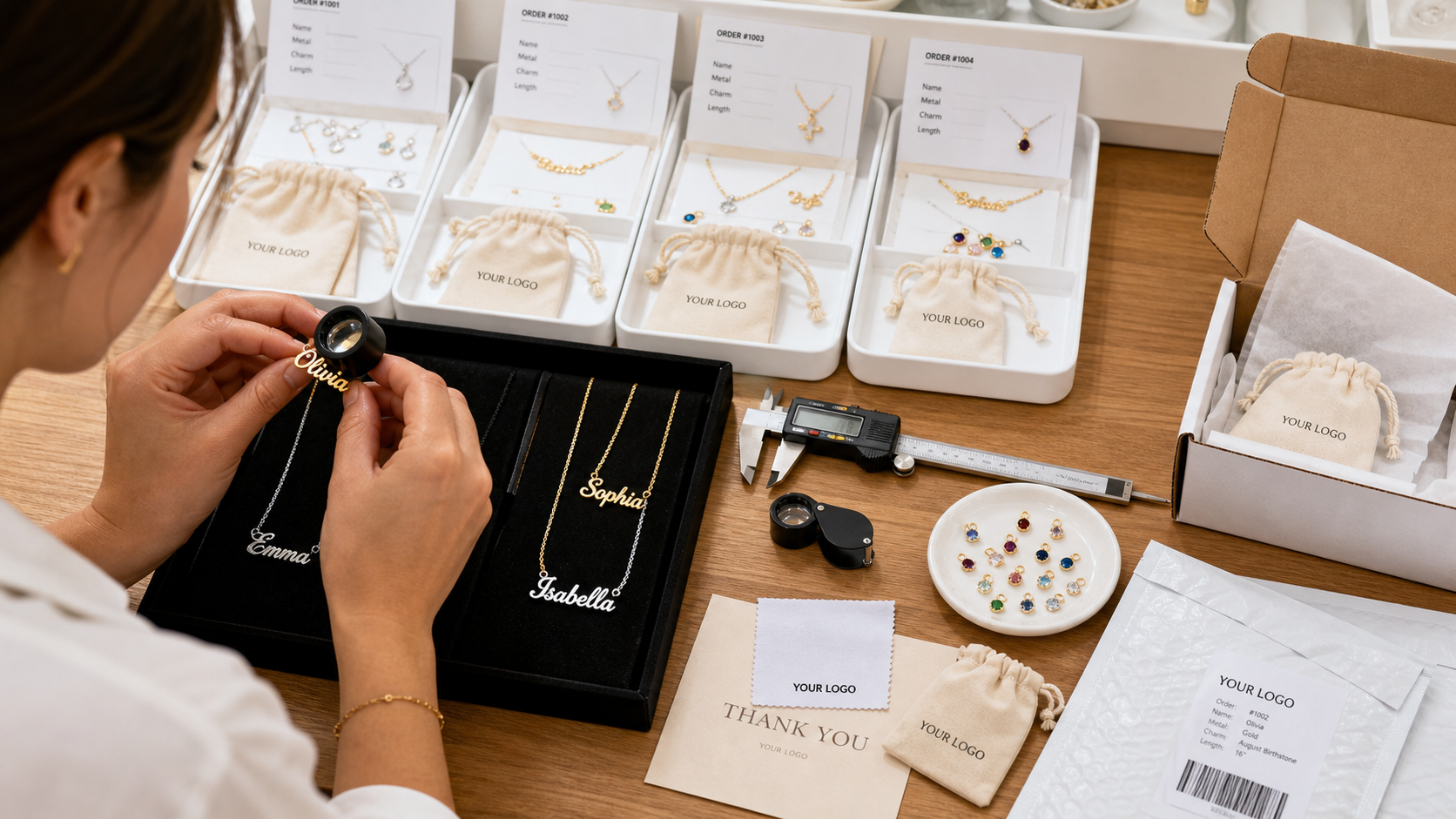
3. Make private-label packaging support the review strategy
Personalized jewelry is often purchased as a gift, so packaging affects the moment of truth. A pouch, jewelry box, thank-you card, polishing cloth, or small care card can make the product feel more intentional. Sellers who want a stronger brand experience should evaluate Artshiney brand services before scaling a personalized jewelry line.
The important detail is brand ownership. Merchant packaging should carry the merchant’s identity, not the supplier’s mark. That is why private-label packaging, insert cards, and pouches should use the seller’s logo or neutral text such as YOUR LOGO in production planning, while Artshiney remains the supplier relationship behind the scenes.
Channel strategy: Shopify, Etsy, WooCommerce, Wix, and BigCommerce
The same personalized necklace can require different merchandising by channel. A Shopify seller may use paid social and email flows to build a branded collection. Etsy sellers often need clearer gift keywords, faster answers to customization questions, and review-friendly packaging. WooCommerce, Wix, and BigCommerce sellers may need better page structure, variant clarity, and repeat-purchase bundles.
| Seller channel | What matters most | Personalized jewelry risk | Practical response |
|---|---|---|---|
| Shopify | Conversion rate, repeat purchase, creative testing | Ad traffic can expose unclear options quickly | Test one hero product, then add bundles and email flows |
| Etsy sellers | Gift search, reviews, customization questions | Misunderstood personalization can hurt ratings | Use precise listing photos, option examples, and packing consistency |
| WooCommerce | Product-page control and checkout clarity | Variant complexity can confuse customers | Keep form fields simple and proof order notes carefully |
| Wix | Visual storytelling and small-brand positioning | Beautiful pages may still miss operational details | Pair lifestyle content with clear material, length, and processing notes |
| BigCommerce | Catalog structure and scaling product families | Too many variants can become hard to maintain | Group personalization options by collection and fulfillment rule |
For sellers who want to connect product sourcing, customization, private-label packaging, and fulfillment planning in one supplier conversation, Artshiney as a custom jewelry supplier is the natural starting point.
Content ideas that convert without overpromising
The best social content for personalized jewelry does not need exaggerated claims. It needs clarity. Show the product detail, the choice process, and the finished order. This is especially important for custom jewelry because shoppers want to understand what they will receive.
Use detail-first content
Short videos should show the chain texture, pendant thickness, clasp, stone color, engraving or name-plate finish, and packaging. A seller can create one video for spelling accuracy, one for metal-color comparison, one for gift packaging, and one for a customer-style story such as “three charms for three sisters.”
Use bundles to increase AOV and reduce decision fatigue
Personalized jewelry can support simple bundles: name necklace plus birthstone charm, bracelet plus initial charm, bridesmaid set, mother necklace with children’s birthstones, or a gift box upgrade. Bundles should remain easy to fulfill. Too many choices can increase customer-service load and production mistakes.
Use post-purchase inserts to invite reviews
A care card and review request can help customers understand how to store the jewelry, avoid unnecessary returns, and share the finished piece. If the product is gift-ready, the insert should feel like part of the brand experience rather than an afterthought.
Supplier questions sellers should ask before scaling
Before increasing ad spend, merchants should ask practical questions about production and fulfillment. Can the supplier handle repeated spelling checks? Are material and finish options consistent across batches? Can packaging be kept stable if order volume rises? Is the seller able to get enough product photography and sample content before launch?
Artshiney gives sellers a way to plan custom jewelry sourcing with product selection, brand-service thinking, and ecommerce fulfillment needs in mind. Sellers should still test samples, review their own store policies, and make sure their claims match what the product and packaging can consistently deliver.
FAQ
Is personalized jewelry still worth selling in 2026?
Yes, but sellers should avoid treating it as a generic trend. Google Trends checks for this article showed stronger recent relative interest in name necklace and charm necklace searches, while current ecommerce jewelry coverage continues to emphasize individualized, story-led products. The opportunity is strongest when personalization is paired with reliable QC, clear options, and consistent packaging.
What personalized jewelry product should a new seller test first?
A name necklace or charm necklace is often a practical first test because shoppers understand the value quickly. The seller should limit options at launch, verify production quality, and add birthstone or gift-box upsells only after the core product is stable.
Can Etsy sellers use Artshiney?
Artshiney can support Etsy sellers as ecommerce jewelry merchants, especially for custom jewelry sourcing, packaging planning, and fulfillment workflows. Sellers should not describe this as a direct Etsy app integration unless they have verified that specific integration in their own account.
How does private-label packaging affect reviews?
Private-label packaging can improve perceived value and make the order feel gift-ready. It also reduces confusion because the customer experiences the seller’s brand from product page to unboxing. That consistency can support better reviews when the product, delivery timing, and personalization are accurate.
What should sellers avoid when launching custom jewelry?
Avoid too many options, unclear spelling rules, unsupported material claims, weak packaging, and vague delivery promises. Personalized jewelry customers notice details, so the fulfillment process must be designed around accuracy.
Start with a focused personalized jewelry line
The strongest seller move is not to chase every trend at once. Start with a focused line: one name necklace, one charm necklace structure, one packaging direction, and one clear content plan. Then measure which search terms, videos, product photos, and bundles create the best conversion and review signals.
If you want to build a personalized jewelry collection with custom sourcing, private-label packaging, and ecommerce fulfillment in mind, start with Artshiney today.