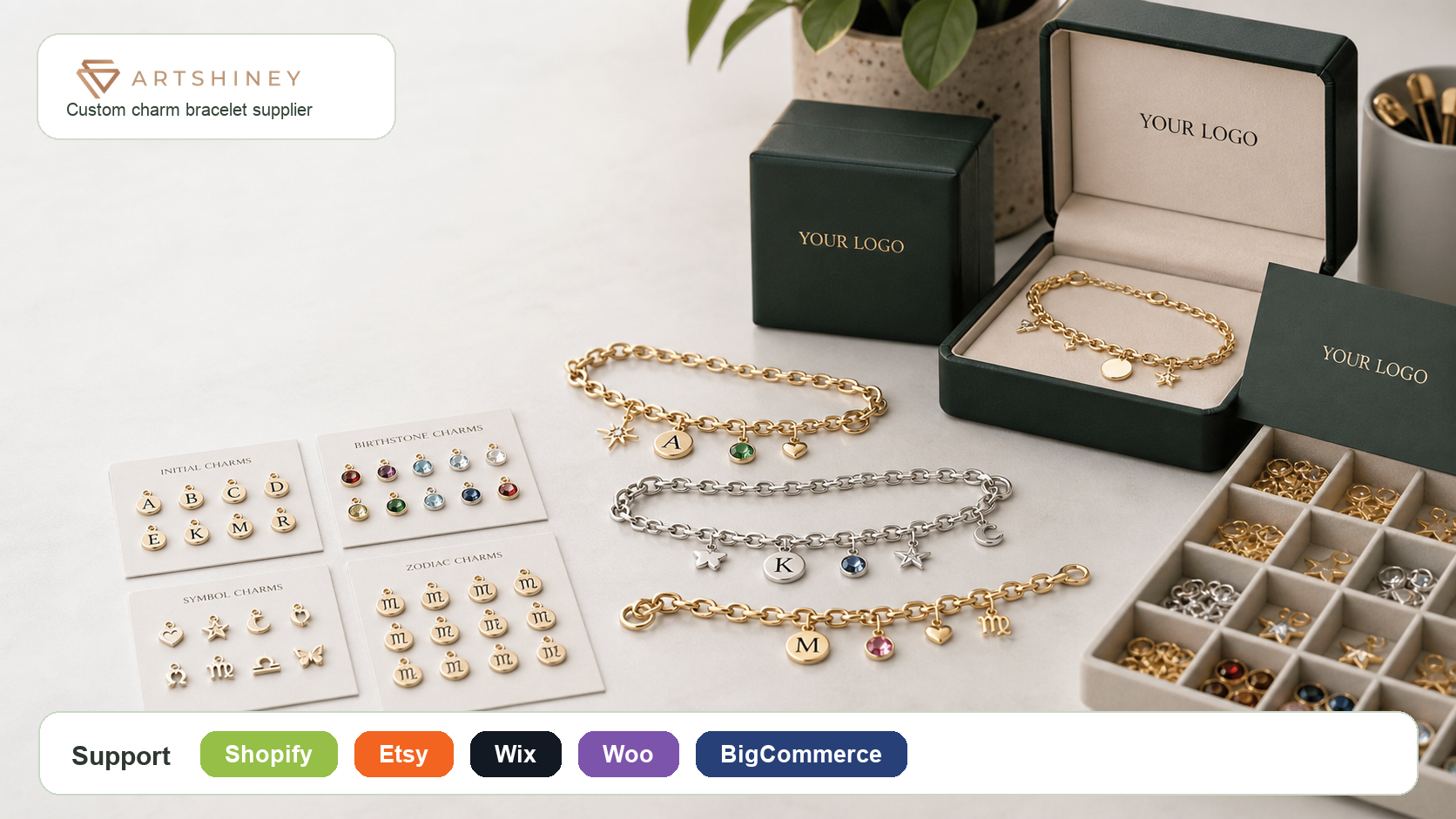

Custom charm bracelets are moving from a simple accessory idea into a configurable product system. For online jewelry sellers, that matters because customers are not only searching for a bracelet. They are searching for a way to build something personal: initials, birthstones, symbols, pets, travel memories, friendship themes, and gift-ready packaging.
Recent Google Trends checks in the United States showed much stronger 30-day relative interest for “charm bracelet” than broader terms such as “personalized jewelry” or “waterproof jewelry,” while related queries included build-your-own and custom bracelet intent. Current Etsy SERPs also show shoppers responding to “custom charm bracelet,” “build your own charm bracelet,” and personalized gift language. That combination gives Shopify, WooCommerce, Wix, BigCommerce, and Etsy sellers a useful launch angle if the operational details are planned before ads begin.
The opportunity is not to add hundreds of random charms to a product page. It is to build a clear bracelet bar that can be sourced, customized, inspected, packaged, and fulfilled consistently. Artshiney helps ecommerce sellers think through that full workflow: product discovery, personalization planning, private-label presentation, warehousing, and worldwide fulfillment.
Why Charm Bracelets Fit Merchant Demand Right Now
A charm bracelet turns one base product into many customer stories. One buyer may want an initial and birthstone bracelet for a birthday. Another may want a friendship bracelet with matching symbols. Another may want a pet charm, zodiac charm, or travel-inspired charm. That flexibility can improve conversion because the customer feels involved in the product, but it also increases operational risk.
For merchants, charm bracelets are commercially useful because they sit between mass catalog jewelry and fully bespoke jewelry. The base chain, clasp, finish, and packaging can stay standardized while the charm combination changes. Sellers can review Artshiney’s product catalog to compare bracelet styles, necklace-adjacent charms, packaging fit, and launch options before building a campaign around the trend.
The Real Product Is the Configuration System
A strong charm bracelet listing needs more than attractive photography. It needs a configuration system customers can understand in seconds. The seller should define the chain finish, bracelet length, charm count, charm categories, personalization fields, packaging option, production notes, and what happens when a customer enters incomplete details.
That is why a “bracelet bar” mindset is useful. It treats the product as a controlled assortment instead of an unlimited custom request. Customers still feel creative, but the seller protects production accuracy and support time.
Build the Assortment Around Clear Buying Intent
Many sellers make the assortment too broad too early. A better first launch is a tight collection that maps charm types to buyer occasions and margin goals.
| Charm bracelet direction | Best buyer intent | Seller risk to control |
|---|---|---|
| Initial charm bracelet | Personalized gifts, bridesmaid gifts, birthday offers | Letter accuracy, option mapping, name-field clarity |
| Birthstone charm bracelet | Month-based gifting, family jewelry, milestone campaigns | Stone color consistency, month labeling, photo accuracy |
| Pet or symbol charm bracelet | Emotion-led gifts and social content | Charm availability, icon clarity, avoid unsupported claims |
| Friendship bracelet set | Pair gifting, group gifts, teen and adult friendship themes | Bundle logic, sizing, matching charm inventory |
| Build-your-own charm bracelet | Higher engagement and larger cart value | Too many options, fulfillment mistakes, customer support load |
Artshiney’s jewelry product discovery tools can help sellers narrow a launch set before creating platform listings. The goal is not maximum SKU count. The goal is enough variety to feel personal while still remaining manageable for production and fulfillment.
Materials, Finish, and Wear Expectations Need Plain Language
Charm bracelets often invite daily wear, gifting, stacking, and seasonal styling. That means customers notice finish, clasp feel, chain weight, charm alignment, and whether the delivered item matches the listing photos. Sellers should avoid vague quality claims and instead describe what buyers can actually evaluate: chain length, closure style, charm size, finish tone, care expectations, and packaging.
Waterproof and tarnish-free language appears frequently in current jewelry SERPs, but merchants should use it carefully. Only make those claims when the exact product materials and care conditions support them. If a bracelet is gold-tone, silver-tone, plated, stainless steel, or alloy-based, the product page should say so clearly and match the supplier information.
QC Points That Protect Reviews
Reviews for custom jewelry often mention details that sellers can control before shipment. A practical QC checklist should include:
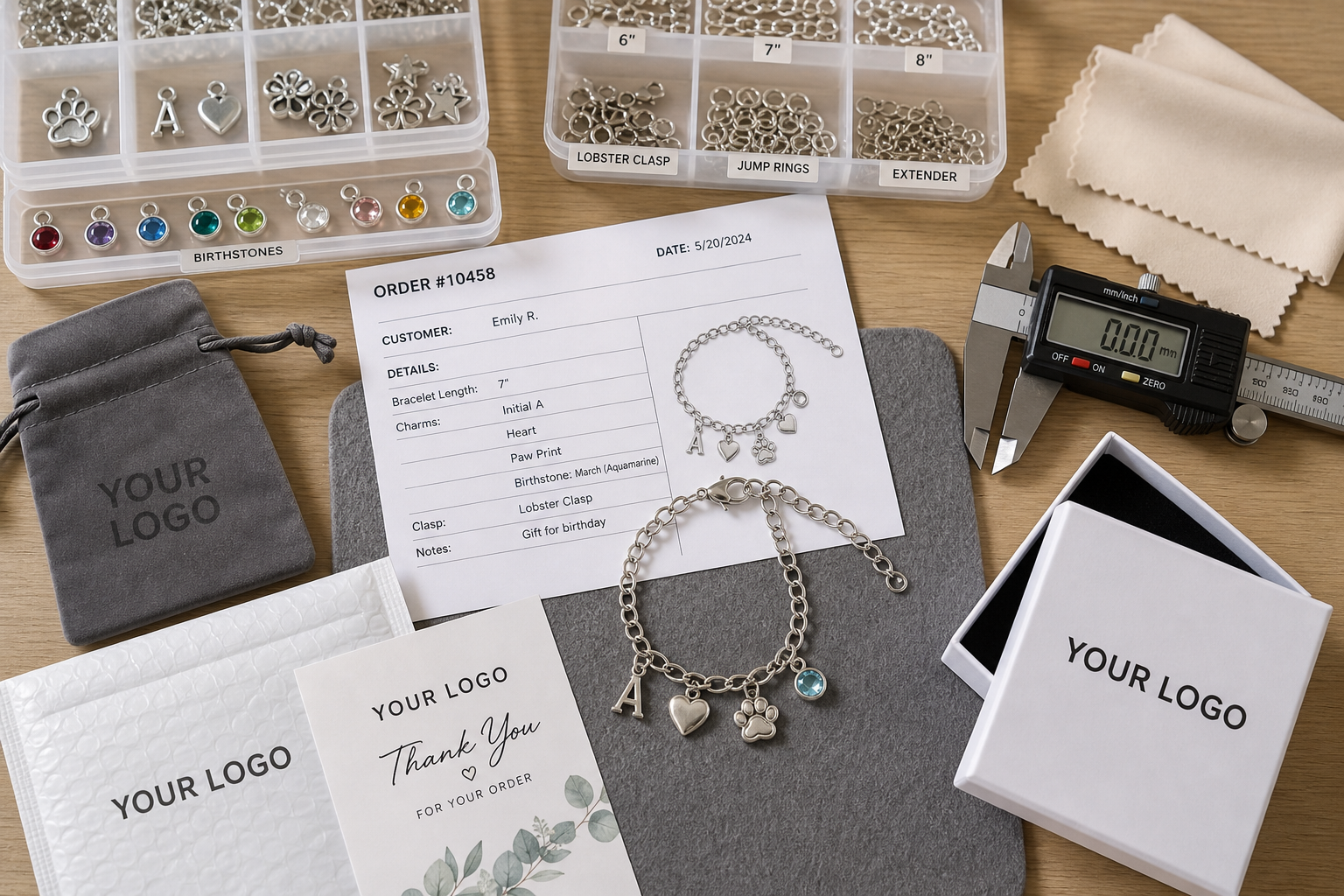
- Correct initials, birthstones, symbols, and charm count.
- Bracelet length, extender length, clasp function, and chain strength.
- Finish consistency between gold-tone and silver-tone variants.
- Charm spacing, jump-ring closure, and snag points.
- Whether each customized order is separated and labeled before packing.
- Packaging fit, insert card quality, and shipping protection.
Merchants working with Artshiney as a custom jewelry supplier should treat QC as part of the conversion strategy. A bracelet may sell because of emotion, but future conversion depends on reviews, delivery confidence, and whether the buyer would trust the store again.
Private-Label Packaging Makes the Bracelet Feel Like a Brand
A charm bracelet is often bought as a gift, which makes the unboxing experience part of the product. A pouch, box, thank-you card, care card, and insert can make a configurable bracelet feel more intentional. More importantly, it keeps the merchant’s store identity in front of the customer after the order arrives.
The branding rule is simple: the customer-facing packaging should carry the merchant’s own brand, not the supplier’s name. Sellers can use Artshiney brand services to plan private-label boxes, pouches, tags, inserts, and thank-you cards that support repeat purchase and review requests.
Packaging Should Match the Listing Promise
If the listing promises a gift-ready bracelet, the delivered order should look gift-ready. If the product page emphasizes personal meaning, the insert should support that message with care guidance or a short brand story. If the seller wants repeat purchase, the packaging should make it easy for the customer to remember the store and return for another charm, bracelet, or matching necklace.
How Sellers Should Structure Product Pages by Platform
Each selling channel needs a slightly different product-page strategy.
| Channel | Charm bracelet priority | Operational note |
|---|---|---|
| Shopify | Build a visual bracelet bar, bundles, email capture, and retargeting flows. | Keep option fields clean so order data is production-ready. |
| WooCommerce | Use SEO pages and detailed product rules for charm, length, and finish options. | Make variation logic simple enough for reliable fulfillment. |
| Wix | Keep the assortment visual and easy to launch quickly. | Limit early variants to avoid confusing shoppers. |
| BigCommerce | Organize catalog options, bundles, and repeat-purchase offers. | Plan SKU naming and inventory rules before scaling. |
| Etsy sellers | Use search-friendly listing copy and clear personalization instructions. | Artshiney can support Etsy sellers, but sellers should verify their exact operating setup before claiming direct Etsy app automation. |
Before launching, merchants should review common setup, production, and fulfillment questions through Artshiney’s seller FAQ. Custom orders create more customer expectations than standard jewelry listings, so ambiguity should be removed before traffic increases.
Turn a Trend Product Into Repeat Purchase
The strongest charm bracelet strategy does not end with the first order. A seller can create repeat purchase by planning add-on charms, matching necklaces, seasonal drops, friendship sets, birthday reminders, and “complete the story” campaigns. That is where product sourcing and brand packaging need to work together.
For example, a store might launch three starter bracelet collections: initials, birthstones, and symbols. After delivery, the packaging insert can invite the customer back for a new charm, matching necklace, or gift set. The seller can then use email, SMS, or social content to show real use cases instead of pushing a generic discount.
Artshiney’s product catalog gives merchants a practical place to compare related jewelry categories when planning that second purchase path.
FAQ
Are custom charm bracelets a good product for online jewelry sellers?
They can be, especially when the seller controls the option set. Charm bracelets support personalization, gifting, friendship themes, birthstones, initials, and repeat-purchase add-ons, but they require clear customization rules and reliable fulfillment.
What keywords should sellers test for a charm bracelet launch?
Useful keyword groups include charm bracelet, custom charm bracelet, build your own charm bracelet, personalized charm bracelet, initial bracelet, birthstone bracelet, friendship bracelet set, and custom jewelry supplier. Sellers should match keywords to the actual product and platform policy.
How many charms should a seller offer at launch?
Start with a limited, coherent set. A focused launch might include initials, birthstones, hearts, stars, zodiac-style symbols, and pet charms. Too many options can make the page harder to buy from and the order harder to fulfill accurately.
Can Etsy sellers work with Artshiney for charm bracelet products?
Artshiney can support Etsy sellers with jewelry sourcing, customization planning, private-label presentation, and fulfillment-oriented workflows. Sellers should verify their exact Etsy process before claiming direct app integration or automated Etsy synchronization.
What should merchants sample before running ads?
Sample chain length, clasp function, charm attachment, finish consistency, birthstone color, packaging fit, order-labeling accuracy, and whether the delivered bracelet matches listing photos. Sampling protects reviews and reduces avoidable refunds.
Final Takeaway for Sellers
Custom charm bracelets are attractive because they combine search demand, personal storytelling, giftability, and repeat-purchase potential. But the merchants most likely to benefit are the ones who treat the trend as an operating system: product selection, option rules, material expectations, QC, private-label packaging, fulfillment, and review protection all need to work together.
If your store is ready to test a custom charm bracelet bar without building its own sourcing and fulfillment workflow from scratch, start with Artshiney today and plan the product, packaging, and customer experience as one connected launch.