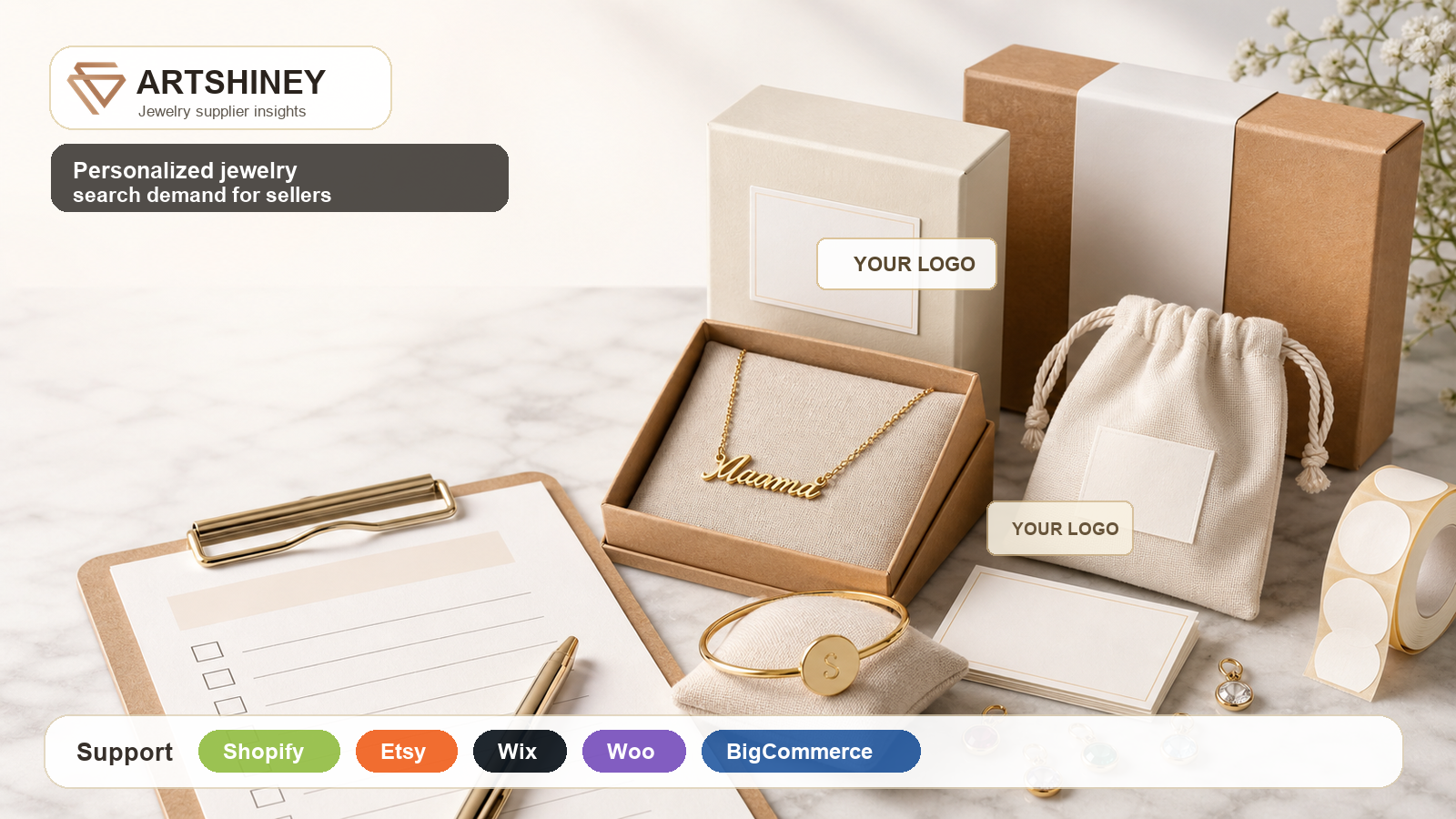

Personalized Jewelry Search Demand: A Seller Guide for 2026
Personalized jewelry remains one of the few jewelry categories where search intent, gift intent, and brand-building intent can meet in the same product page. Current search results around personalized jewelry, name necklaces, custom jewelry suppliers, private-label jewelry dropshipping, and Etsy jewelry selling show a clear pattern: shoppers want pieces that feel personal, while merchants want sourcing and fulfillment systems that can handle customization without turning every order into a manual problem.
That is the real opportunity for Shopify, WooCommerce, Wix, BigCommerce, and Etsy sellers. A name necklace, initial bracelet, birthstone charm, engraved pendant, or gift-ready jewelry set can attract search demand, but the seller still has to protect conversion rate, reviews, fulfillment timing, packaging consistency, and repeat purchase. Artshiney can fit this workflow as a jewelry supplier for merchants who want custom jewelry sourcing, private-label presentation, and seller-focused fulfillment planning.
Why personalized jewelry search demand matters now
The current SERP context is useful because it is not only showing fashion inspiration. It is also showing supplier pages, print-on-demand jewelry services, private-label dropshipping claims, Etsy seller advice, birthstone trend content, and multi-channel ecommerce examples. That mix tells sellers something important: personalized jewelry is no longer just a product trend. It is a search-driven operations category.
Google Trends access was rate-limited during this run, so this article does not invent numeric index values. Instead, the topic selection is based on live search context, recent published jewelry trend coverage, and the visible supplier/SERP competition around personalized jewelry, name jewelry, private-label packaging, and Shopify/Etsy seller workflows. For a merchant, that is still actionable: the search market is rewarding useful, specific, operations-aware content, not only pretty product photos.
Personalization is a product system, not a single SKU
A seller can easily add a personalized necklace to a store and still lose money if the workflow is weak. Custom text must be captured correctly. Materials must be described accurately. Chain length, clasp style, plating tone, stone color, engraving position, and packaging must stay consistent. Customer service needs clear rules for misspellings, production timing, and gift deadlines.
This is why sellers should treat personalized jewelry as a launch system. Artshiney’s product catalog can help merchants compare product directions before they commit to a narrow test range, while Artshiney’s jewelry product discovery tools can support product selection when sellers want to build around audience, occasion, material expectation, or price point.
| Seller decision | Why it affects sales | Operational risk to control |
|---|---|---|
| Name necklace or initial bracelet | Strong gift and identity intent can improve product relevance. | Spelling, font readability, chain strength, and production proofing. |
| Birthstone or charm add-ons | Customers can personalize without requiring a fully new design. | Stone color accuracy, charm placement, and variation complexity. |
| Private-label packaging | Gift-ready presentation can support reviews, unboxing content, and repeat orders. | Logo placement, box/pouch consistency, insert accuracy, and damaged packaging. |
| Dropshipping or made-to-order fulfillment | Inventory-light testing helps sellers avoid overbuying unproven styles. | Production timing, shipping promises, tracking communication, and return expectations. |
| Multi-channel listings | Shopify, WooCommerce, Wix, BigCommerce, and Etsy sellers can reuse a proven product story. | Conflicting titles, materials, delivery promises, and personalization instructions. |
Start with a narrow personalization menu
A practical first launch might include one name necklace, one initial bracelet, one birthstone charm option, and one gift-ready set. That is enough to test search demand and creative positioning without creating too many customization paths. When sellers add too many fonts, stones, chain lengths, finishes, and packaging choices at once, the product page becomes harder to understand and the fulfillment team has more places to make mistakes.
Material expectations shape trust and reviews
Personalized jewelry buyers often care about emotion first, but they review the product based on physical details. Is the name easy to read? Does the chain feel appropriate for the pendant? Does the finish match the photo? Does the bracelet clasp work smoothly? Does the birthstone color look close to the listing image? Does the box arrive clean enough to give as a gift?
Sellers should avoid vague claims such as “best quality” unless the listing explains what quality means. Use clear material language, realistic care guidance, and accurate photos. If a piece uses stainless steel, sterling silver, brass, alloy, plating, enamel, acrylic, rhinestone, cubic zirconia, or natural-style stones, the product page should set the right expectation. Customers forgive normal product limits more easily than they forgive surprises.
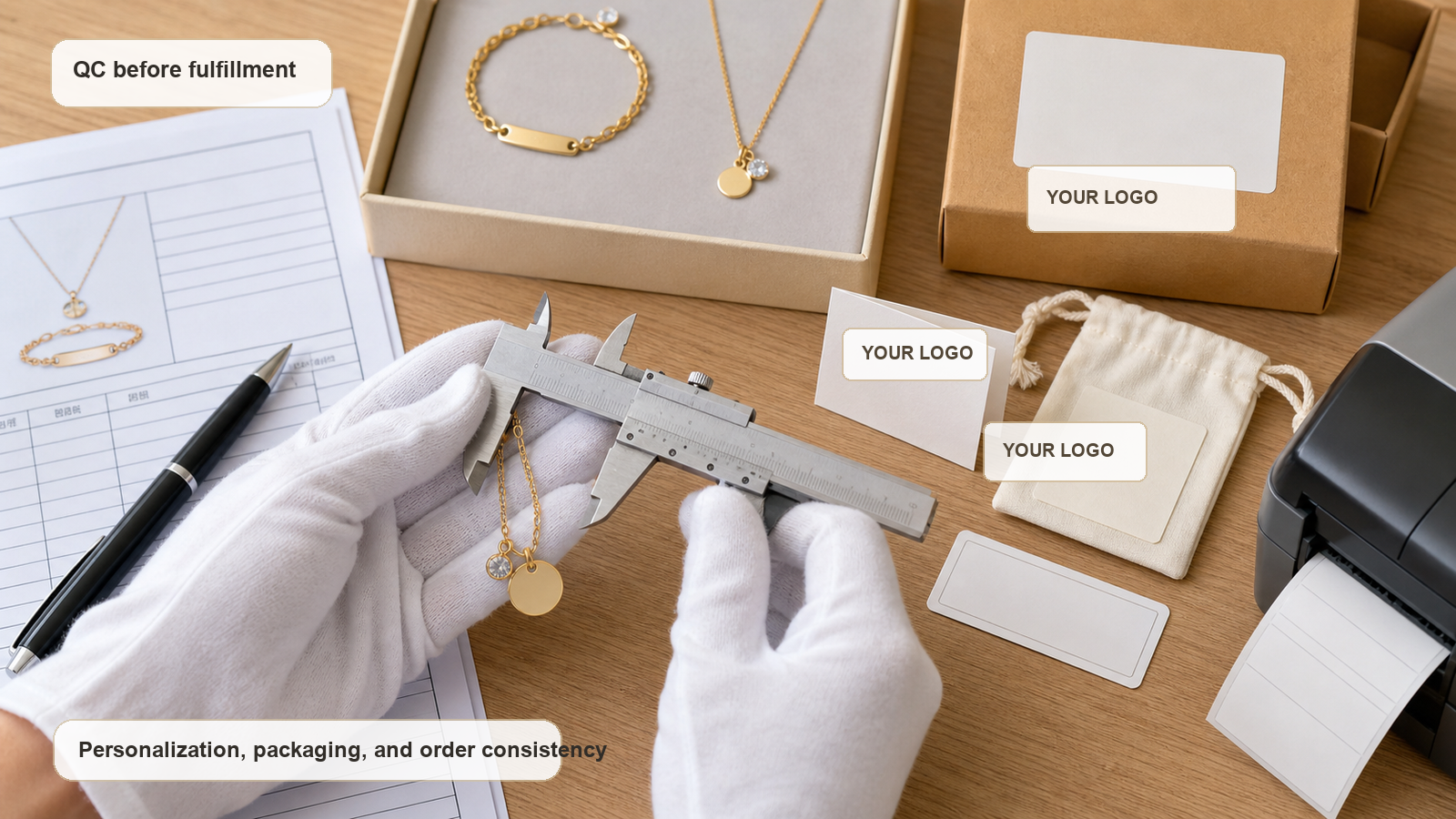
Packaging is part of conversion, not an afterthought
Personalized jewelry often enters the customer’s life as a birthday gift, bridesmaid gift, graduation keepsake, anniversary order, memorial piece, family gift, or self-purchase with emotional meaning. That makes packaging commercially important. A small necklace in a clean box with a brand pouch, thank-you card, and care insert can feel more valuable than the same necklace in inconsistent generic packaging.
Private-label presentation should belong to the seller’s own store. Boxes, pouches, thank-you cards, labels, inserts, and jewelry cards should use the merchant’s brand, not the supplier’s name. Artshiney brand services are relevant for sellers who want product sourcing and brand presentation to feel connected, especially when they are building a repeatable unboxing experience across multiple product launches.
Think about the review before the order ships
A good review usually starts before the customer opens the package. The product page should set the right material and timing expectation. The personalization field should be hard to misunderstand. The order should be checked against the customer’s input. The package should feel ready to gift. If those details align, the seller has a better chance of earning public trust and repeat purchase.
How platform context changes the launch plan
Shopify and BigCommerce sellers often have more control over landing pages, bundles, paid traffic, email flows, and post-purchase offers. WooCommerce and Wix sellers may prioritize page clarity, product option usability, site speed, and clean photography. Etsy sellers need marketplace-specific titles, personalization fields, shipping expectations, review protection, and an honest handmade/custom positioning strategy.
For Etsy, wording should stay accurate. Unless a direct Etsy app integration has been verified, sellers should describe Artshiney as supporting Etsy sellers with products, private-label planning, and fulfillment workflow, not as an Etsy app integration. Multi-channel sellers should keep product names, photos, materials, and delivery promises consistent so the same item does not tell different stories on different storefronts.
Before launching across platforms, review Artshiney’s seller FAQ and confirm how the supplier workflow fits your account setup, product planning, ordering process, and customer support standards. A supplier FAQ will not replace your margin model, but it can reduce avoidable confusion before the first batch of orders arrives.
A practical QC checklist for personalized jewelry sellers
Quality control for personalized jewelry should be written down before ads go live. The goal is not to slow the seller down. The goal is to avoid preventable issues that become refund requests, poor reviews, or expensive customer service threads.
- Confirm spelling, initials, date formats, engraving notes, stone choices, chain length, finish, and quantity before production.
- Check whether the finished piece matches the product photo closely enough for color, scale, and layout.
- Review clasp function, chain strength, charm alignment, pendant readability, and surface finish.
- Keep packaging consistent across box, pouch, jewelry card, thank-you card, label, and insert.
- Set realistic production and shipping expectations on every sales channel.
- Track issues by SKU so weak components, confusing fields, or high-risk customization options can be removed quickly.
This is where Artshiney as a custom jewelry supplier can support more than product discovery. The stronger supplier relationship is the one that helps a seller keep personalization, packaging, fulfillment, and customer expectations aligned as order volume changes.
How to turn demand into a lower-risk launch
Personalized jewelry can tempt sellers to overbuild because every name, stone, color, and symbol feels like a new opportunity. A lower-risk launch does the opposite. Start with a controlled product set, use a small number of personalization options, document the QC process, prepare private-label packaging, and test on the channel where your audience is strongest.
After the first orders, review conversion rate, personalization errors, customer questions, production timing, packaging feedback, and review language. If the product performs well, expand in the direction the data supports: another finish, a matching bracelet, a birthstone variation, a bundle, a seasonal gift page, or a second channel. Start with Artshiney today if you want a custom jewelry supplier workflow built around ecommerce sellers, private-label presentation, and scalable product sourcing.
FAQ: personalized jewelry search demand for sellers
What personalized jewelry products should sellers test first?
Name necklaces, initial bracelets, birthstone charms, engraved pendants, and simple gift-ready sets are practical first tests because customers understand them quickly and sellers can control the customization menu.
Is personalized jewelry only useful for Etsy stores?
No. Etsy has strong gift and personalization behavior, but Shopify, WooCommerce, Wix, and BigCommerce sellers can use personalized jewelry for landing pages, bundles, email flows, seasonal campaigns, influencer drops, and repeat-purchase programs.
Why does private-label packaging matter so much?
Packaging turns a small item into a branded experience. For personalized jewelry, that can affect perceived value, gift readiness, unboxing behavior, review quality, and whether the customer remembers the store after the first purchase.
How can sellers avoid personalization mistakes?
Use clear input fields, limit options during the first launch, confirm spelling and variation choices before production, and track errors by SKU. If one product causes repeated customer service issues, simplify it before scaling traffic.
How can Artshiney support a personalized jewelry launch?
Artshiney supports ecommerce jewelry merchants with product sourcing paths, custom jewelry options, product discovery, private-label brand services, and seller-facing workflow pages that help merchants plan beyond a single trending product.
Final takeaway
Personalized jewelry search demand is valuable because it connects customer emotion with merchant differentiation. But the merchants who benefit most will not be the ones who add the most options. They will be the ones who make personalization easy to understand, easy to produce, easy to package, easy to ship, and easy for customers to trust. For sellers building that kind of launch, Artshiney brand services and the broader Artshiney supplier workflow can turn search demand into a cleaner ecommerce growth plan.