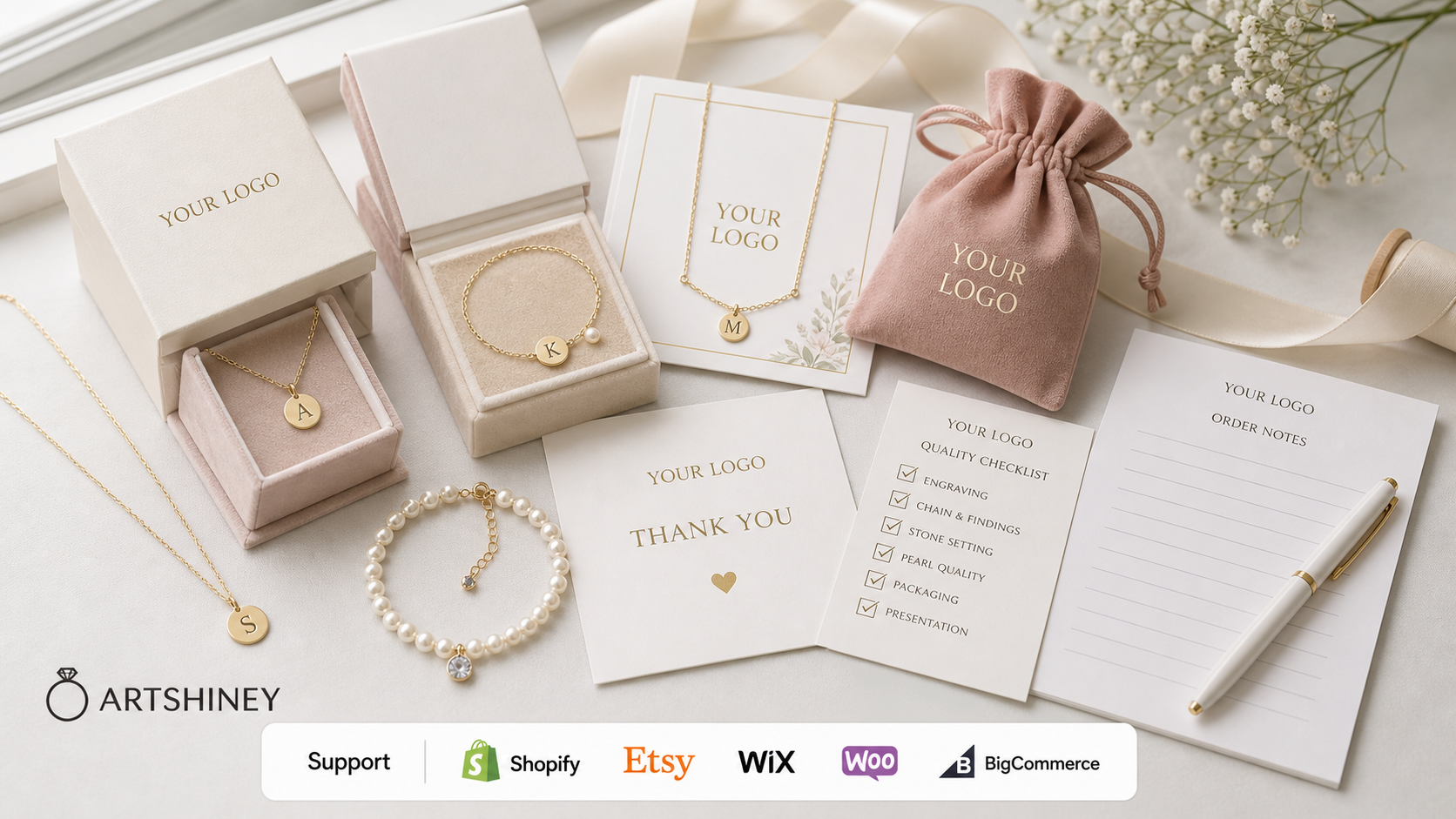

Wedding Season Jewelry Supplier Guide for Sellers
Wedding season creates a different kind of jewelry demand than a normal fashion trend. A customer buying for a bridal party is not just choosing a necklace or bracelet. They are buying timing, personalization accuracy, emotional meaning, packaging quality, and confidence that every piece in a set will arrive consistently. For Shopify, WooCommerce, Wix, BigCommerce, and Etsy sellers, that makes personalized wedding jewelry attractive but operationally sensitive.
Current Google and SERP context points toward a useful merchant opportunity: 2026 wedding content is emphasizing personal stories, bridal-party gifts, favors, pearls, initials, charms, and detail-rich presentation. Summer jewelry coverage also favors more expressive accessories rather than anonymous basics. The commercial lesson is clear: sellers should not launch generic wedding jewelry. They should build small, controlled collections with a supplier workflow that protects quality, branding, fulfillment, and reviews.
For sellers using Artshiney, wedding season should be treated as a structured product program: choose repeatable designs, define personalization rules, prepare private-label packaging, set realistic production expectations, and use each order as a chance to create repeat purchases after the wedding.
Why wedding jewelry is a high-intent seller opportunity
Wedding jewelry often carries higher intent than everyday accessory browsing. The buyer may need five to ten coordinated pieces, a bride gift, a maid-of-honor version, matching packaging, and a gift note. That bundle behavior can lift average order value, but it also raises the cost of mistakes. One wrong initial, one mismatched finish, or one late package can affect the whole order.
This is why merchants should evaluate wedding jewelry from both a merchandising and fulfillment perspective. A design that photographs beautifully but requires too many manual choices can create support tickets and remake costs. A simpler initial necklace, pearl bracelet, birthstone charm, or engraved bar bracelet may convert better if the customer can understand the personalization flow quickly.
Choose products around the wedding buyer moment
The best wedding-season collection starts with use cases, not just materials. A bridesmaid gift has different expectations than a bride’s keepsake or a wedding favor. Sellers should decide which moments they want to serve before choosing SKUs, photos, packaging, and listing copy.
| Buyer moment | Best product direction | Merchant risk to control |
|---|---|---|
| Bridesmaid proposal gift | Initial necklace, pearl bracelet, small birthstone charm, coordinated card | Bulk personalization errors, uneven packaging, unclear delivery window |
| Maid-of-honor or bride gift | Premium finish, engraved message, subtle stone accent, keepsake box | Material expectations, engraving readability, perceived value |
| Wedding favor | Simple charm bracelet, minimal pendant, batch-friendly packaging | Unit cost, order quantity, repetitive QC, packing speed |
| Post-wedding thank-you gift | Everyday wearable piece with initials, date, or small custom detail | Delayed reorder demand, inventory planning, consistent finish across batches |
Artshiney’s product catalog can help sellers compare base necklace, bracelet, charm, and packaging options before committing to a full campaign. The goal is not to offer every possible wedding accessory; it is to build a line that is easy to explain, easy to personalize, and easy to fulfill repeatedly.
Build personalization rules before writing the listing
Personalized wedding jewelry fails when the product page leaves too much room for interpretation. A seller should define exactly where an initial appears, how many characters can be engraved, which finish options are available, whether stones are symbolic or decorative, and how the customer should enter bridal-party names or initials.
For Shopify and WooCommerce sellers, the personalization form can be structured with fields and helper text. For Etsy sellers, the listing description and personalization box need even more discipline because customers often ask for exceptions. Wix and BigCommerce sellers should keep the same rules visible in product photos, FAQ copy, and order confirmation emails.
Use Artshiney’s jewelry product discovery tools to assess whether a design is simple enough for repeatable personalization. A wedding product should not depend on hidden manual judgment. If a supplier, seller, and customer can all understand the rule from the same product page, the launch is more likely to scale cleanly.
Quality control matters more when customers buy sets
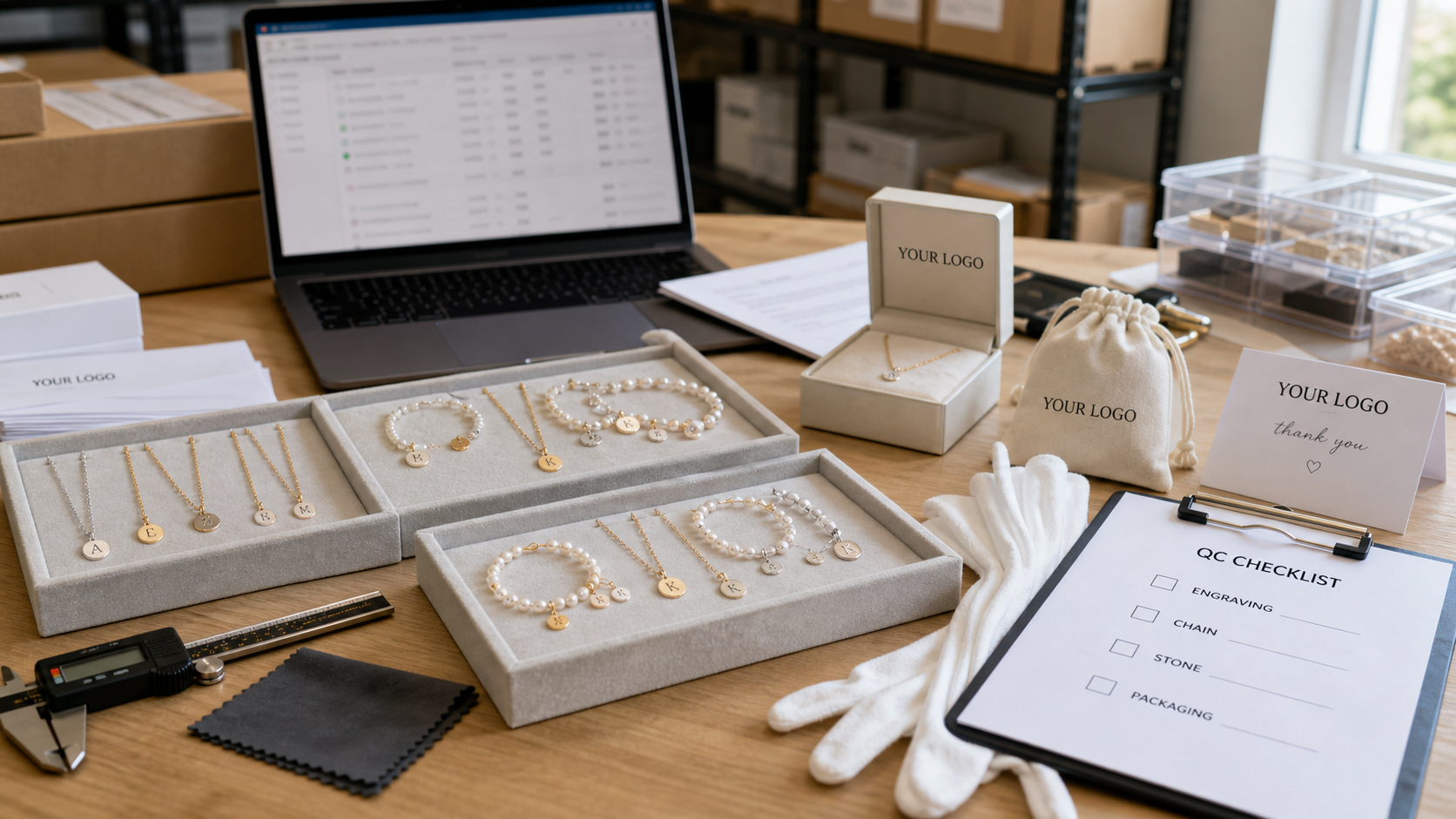
A single accessory order can survive a small inconsistency. A bridal-party set cannot. Customers compare each piece side by side, so chain color, clasp feel, pearl size, stone tone, engraving depth, and box presentation need to stay consistent across the order. Sellers should make QC visible in their internal workflow, even if it is invisible to the customer.
Artshiney as a custom jewelry supplier should be evaluated as part of that risk plan. Before advertising heavily, merchants should sample the exact product, inspect how personalization looks in real light, compare multiple pieces in one set, and confirm packaging fit. Strong QC does not only prevent refunds; it protects the reviews that future wedding customers will read before ordering.
Packaging turns a supplier product into a merchant brand
Wedding buyers judge the whole unboxing experience. A delicate necklace in a plain bag may look acceptable in a product photo, but it may not feel gift-ready when the buyer is preparing bridal-party boxes. Private-label packaging, a thank-you insert, a pouch, and a clean jewelry box can make the product feel more intentional without changing the jewelry design itself.
This is where Artshiney brand services are especially relevant for merchants. A seller can use packaging to communicate care, reinforce the store name, and reduce the chance that customers perceive the order as generic dropshipping. The packaging should carry the merchant’s brand, while Artshiney remains the supplier and platform partner behind the workflow.
Plan fulfillment around deadlines, not hope
Wedding-season demand is deadline-driven. Sellers need realistic production and delivery language because customers may be ordering for a proposal box, shower, rehearsal dinner, destination wedding, or thank-you package. Overpromising speed can damage reviews faster than a conservative delivery estimate.
A practical seller workflow includes three dates: the personalization cutoff, the production window, and the expected delivery range. If the item requires engraving or multi-piece coordination, the product page should say so plainly. Merchants should also prepare customer service templates for spelling confirmation, bulk-order questions, gift-note edits, and address changes.
How each platform should approach wedding jewelry
| Seller channel | Best launch focus | Operational priority |
|---|---|---|
| Shopify | Landing page for bridal-party sets, bundles, and email capture | Personalization fields, upsells, delivery promises, abandoned-cart recovery |
| WooCommerce | Detailed product pages with customization logic and brand storytelling | Form clarity, plugin compatibility, checkout notes, order export accuracy |
| Wix | Visual gift guide pages for smaller curated collections | Simple SKU rules, clear photos, concise FAQ, mobile readability |
| BigCommerce | Scalable catalog structure for set quantities and finish options | Variant organization, batch QC, repeat orders, support templates |
| Etsy | Personalized bridal-party gift listings and wedding favor angles | Accurate personalization boxes, production time, review-ready packaging |
Artshiney supports Etsy sellers as part of the broader merchant audience, but sellers should not assume a direct Etsy app integration unless they have verified their own workflow. The safer operating model is to use clear listing rules, organized order details, and supplier communication that keeps personalization accurate.
Turn wedding season into repeat purchase potential
Wedding jewelry can lead to more than one event purchase. A bridesmaid who loves an initial necklace may return for birthday gifts, holiday gifts, mother’s jewelry, or a self-purchase piece in another finish. Sellers can plan this by adding care cards, packaging inserts, and post-purchase email flows that invite customers to reorder matching pieces.
Artshiney’s seller FAQ is a useful place for merchants to review operational questions before building a campaign. Sellers should understand product options, customization expectations, fulfillment workflow, and support boundaries before a seasonal spike begins.
Wedding-season launch checklist
- Choose three to six repeatable products instead of a large unfocused wedding catalog.
- Define exact personalization rules for initials, names, dates, stones, finish, chain length, and gift notes.
- Order samples and compare multiple pieces as a set, not only as single items.
- Prepare private-label packaging with the merchant’s brand and gift-ready presentation.
- Write delivery language that separates personalization time from shipping time.
- Create support templates for spelling confirmation, bulk orders, deadline questions, and address changes.
- Use post-purchase inserts and email flows to encourage repeat purchases after the wedding.
FAQ: personalized wedding jewelry for ecommerce sellers
What personalized wedding jewelry should a seller launch first?
Start with products that have clear personalization rules: initial necklaces, pearl bracelets, birthstone charms, engraved bar bracelets, and coordinated bridesmaid sets. These are easier to explain, photograph, quality-check, and fulfill than highly complex custom designs.
Is wedding jewelry suitable for dropshipping?
It can be, but only when the seller controls expectations. Wedding jewelry needs accurate personalization, consistent materials, gift-ready packaging, and reliable delivery language. Generic dropshipping with weak photos and unclear production timing is risky for wedding buyers.
How can Etsy sellers use this strategy?
Etsy sellers can position personalized bridal-party gifts, wedding favors, and keepsake jewelry with clear personalization boxes, accurate processing times, and strong close-up photos. Artshiney can support Etsy sellers as a custom jewelry supplier, but sellers should verify their own order workflow rather than assuming a direct Etsy app integration.
Why does packaging matter for wedding jewelry?
Packaging affects perceived value, review quality, and gift readiness. A jewelry box, pouch, thank-you insert, and brand card can help a merchant’s store feel intentional instead of generic, especially when customers are assembling bridesmaid boxes or wedding favor packages.
How should sellers reduce refund risk?
Use clear personalization rules, sample the product before launch, show realistic photos, confirm bulk-order details, explain production time, and maintain a QC checklist for engraving, chain, stone, finish, packaging, and shipment details.
Start a wedding jewelry collection with Artshiney
Wedding season rewards sellers who combine emotional product ideas with disciplined operations. If your store is preparing personalized bridal-party gifts, wedding favors, or private-label jewelry bundles, start with Artshiney today and build a collection that is easier to source, brand, quality-check, and fulfill.